It’s 9:47 PM on a Friday, and this is exactly the moment an after-hours answering service for lawyers either earns its keep or doesn’t. A car has just been rear-ended on the interstate. Nobody’s hurt badly, but the other driver was on their phone, and the passenger’s wrist is already swelling.
By the time the tow truck leaves, she’s sitting in her kitchen with a bag of ice, doing what almost everyone does next: Googling “car accident lawyer near me.”
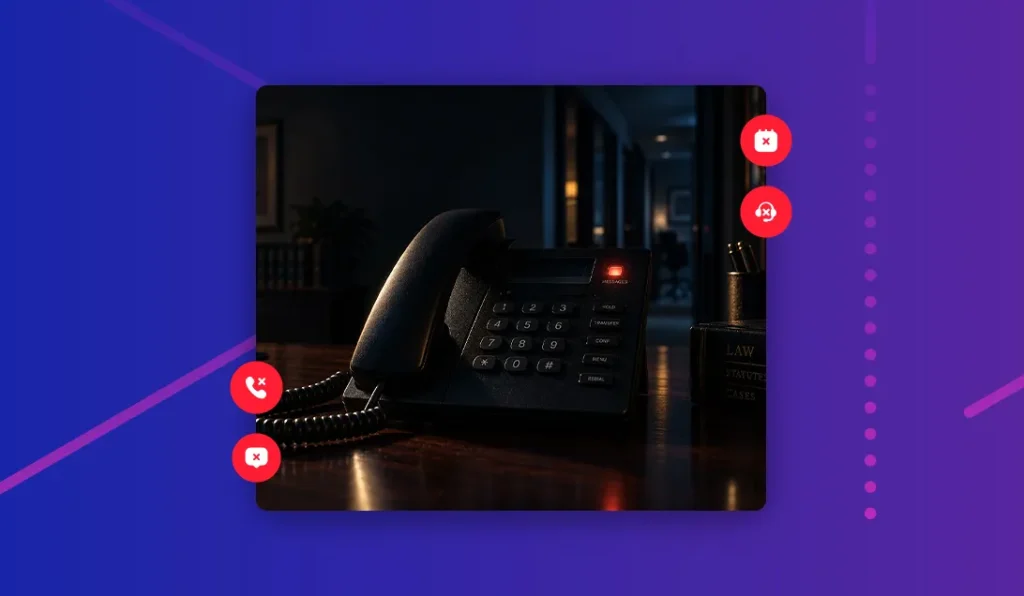
She calls the first firm. It rings four times and rolls to a generic voicemail greeting. She hangs up without leaving a message; she’s not going to explain what happened to a machine at 10 PM.
She calls the second firm. Same thing.
The third firm answers. A real person, calm and clear, asks a few questions, tells her someone will call first thing in the morning, and lets her know what to do in the meantime.
She doesn’t call a fourth firm. She didn’t need three law firms to compare. She needed one to pick up.
That’s the entire competitive landscape for after-hours legal intake, condensed into fifteen minutes on a Friday night. The firms that answer get the case. The firms that don’t usually never even know it existed.
What Is an After-Hours Answering Service for Lawyers?
An after-hours answering service for lawyers is a team of trained receptionists, human, AI, or both, who answer a law firm’s calls outside normal business hours, in the firm’s name, and handle real intake. They gather case details, screen the caller, and get urgent matters to an attorney, instead of just taking a message for the morning.
The difference between that and voicemail isn’t tone. It’s the outcome. Voicemail asks the caller to wait, but an after-hours service starts the case tonight.
Why the Hours After 5 PM Matter So Much for Law Firms
Legal problems don’t check the clock before they happen.
Evenings. Rush-hour accidents peak right as most offices are locking up. Someone served with papers that afternoon spends the evening deciding what to do about it. A worker hurt on a day shift finally has time to search for help once they’re home.
Late nights. Arrests, DUI stops, and domestic incidents cluster overnight. According to the National Safety Council’s analysis of 2024 federal crash data, fatal crashes peak between 4 PM and midnight. That’s exactly the window when the calls asking “do I need a lawyer” start coming in.
Weekends. Recreational injuries, contractor disputes, family blowups that turn into custody questions. Weekends generate their own steady stream of legal needs on a schedule that has nothing to do with a firm’s front-desk hours.
Estimates of exactly how much call volume this adds up to vary by study and practice area, but multiple independent analyses of law firm call patterns put the after-hours share somewhere in the range of 30–40% of total inbound calls, with personal injury and criminal defense trending toward the higher end. However you slice it, that’s not a rounding error. It’s a third or more of the phone traffic a firm’s marketing budget is paying to generate.
What Happens When No One Picks Up
This is where firms lose cases without ever seeing it happen.
Most callers don’t leave a message. Someone stressed, in pain, or in trouble at 10 PM isn’t going to record their situation for a machine. They assume no one will listen until Monday, so they don’t bother.
They call the next name on the list. A caller with an urgent legal problem at 9 PM isn’t going to wait for business hours. They’re going to keep dialing until a person answers.
Firms are hard to reach even in daylight. A 2024 secret-shopper study by Clio found that only 40% of law firms answered the phone at all (down from 56% in 2019), and 48% were essentially unreachable by phone by any method. If that’s the reality during business hours, the after-hours gap is even wider.
Urgency fades by Monday. The person still needs a lawyer. But the panic that would have gotten them to sign that night has cooled, and now they’re comparison shopping instead of committing.
What a Good After-Hours Service Should Actually Do
Answering the phone is the minimum. A service built for law firms should also:
- Answer live, every time: nights, weekends, and holidays, without gaps in coverage.
- Run real intake, using the firm’s own questions, not a generic script.
- Screen for genuine new-client calls, filtering out sales calls, wrong numbers, and matters outside the firm’s practice areas.
- Escalate true emergencies to the on-call attorney immediately, based on the firm’s own rules for what counts as urgent.
- Book the consultation directly, rather than promising a callback that gives a competitor time to get there first.
- Hand off clean notes by morning, so the team opens the office already knowing exactly who called, why, and what’s been done about it.
A service that only does the first item on that list is a fancier voicemail. A service that does all six is a second intake shift.
Human and AI, Configured Together
The strongest after-hours setups don’t force a choice between a live person and automation. They use both, on purpose, for different jobs.
An AI Receptionist is well suited to answering instantly, handling routine questions, and routing calls at 3 AM. A trained human receptionist is better suited to a caller who’s upset, uncertain, or describing something too nuanced for a script to fully capture, and to the judgment calls around what counts as a true emergency.
Abby builds after-hours coverage this way. You choose how each call is handled, human, AI, or both, and you can change the mix at any time. Human and AI receptionists work from the same intake rules and the same call history, so a caller gets a fast, competent response no matter which takes the call, and more than 20 years of receptionist experience trains both. Nights and weekends are part of every plan, with no after-hours upcharge, and a minute with the AI Receptionist counts as half an Abby Minute.
Which Practice Areas Feel This the Most
After-hours coverage helps nearly any firm, but the return is sharpest where the calls are both urgent and time-sensitive:
- Personal injury: accident calls often come in the same evening, when the injury and the stress are both still fresh.
- Criminal defense: arrests happen at all hours, and a family member calling at 2 AM needs a real person, not a recording.
- Family law: custody and divorce calls are emotionally loaded and rarely wait for a convenient hour.
- Immigration: urgent, deadline-driven matters that often also need bilingual intake. Abby’s receptionists, human and AI, answer in English and Spanish on every plan.
What It’s Actually Costing You to Not Answer
Run the math on just one practice area. If a firm’s average case is worth even a few thousand dollars, and after-hours coverage helps it convert one or two more callers a month who would otherwise have gone to voicemail and then to a competitor, the coverage has already paid for itself many times over.
The hard part is that this cost is invisible. Nobody gets a report that says “here’s the case you lost to the firm three search results down because they picked up and we didn’t.” It just shows up later as a slower month, with no obvious cause. If missed calls are already a suspected soft spot for your firm, it’s worth reviewing how to reduce missed calls at your law firm today, before assuming after-hours coverage alone will fix it.
Frequently Asked Questions
It’s a team (human, AI, or both) that answers a law firm’s calls outside business hours, gathers real case information, screens the caller, and escalates true emergencies, so a potential client gets a live response instead of a voicemail.
Not when it’s built for legal intake specifically. A generic call center takes a message. A legal-focused service asks the right intake questions, understands what counts as an emergency for a law firm, and can book a consultation directly.
Often, yes. Sometimes at a higher rate than daytime calls, because after-hours callers tend to be responding to something urgent that’s still fresh. The firm that answers first has a real advantage with this kind of caller.
An AI Receptionist can competently handle routine questions, scheduling, and initial screening at any hour. Calls involving distress, ambiguity, or a judgment call about urgency are usually better handled by a trained human receptionist, and the AI can hand the call to one.
As close to immediately as possible for anything flagged urgent. For everything else, the caller should at minimum know their call was received and that a specific person will follow up when the office opens.
The Calls Are Already Coming
Nobody needs to be convinced that legal problems happen after 5 PM. Everyone already knows that. The only real question is which firm is set up to answer when they do.
See how Abby’s legal answering service combines human and AI receptionists to cover your firm’s calls around the clock, and start a 14-day free trial to see what it catches in the first week alone.