The phone is still where a lot of business is won or lost. Yet a 411 Locals study of businesses across dozens of industries found that fewer than 40% of calls to small businesses are answered by a live person, which means roughly six in ten callers never reach anyone at all. For most of those callers, the next step is simple: they hang up and dial a competitor.
If you have started looking for a way to fix that, you have probably run into two terms used almost interchangeably: virtual receptionist and answering service. They sound similar, and some providers blur the line on purpose, but they are not the same thing. Choosing the wrong one can leave you paying for coverage that does not fit how your business actually works. Here is how they compare, when to use each, and how to decide.
The Quick Answer
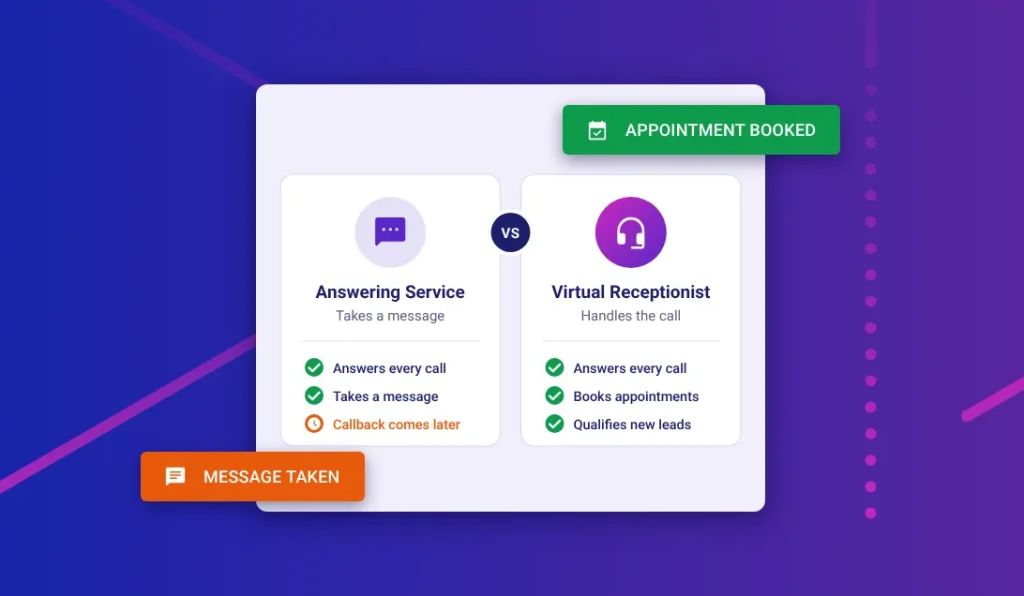
At a high level, an answering service focuses on making sure your calls get picked up, while a virtual receptionist focuses on handling the entire call the way a great in-house employee would. This table breaks down the practical differences:
| Answering Service | Virtual Receptionist | |
|---|---|---|
| Primary focus | Availability and coverage | Full call handling and representation |
| Typical result | Takes a message for you to return later | Resolves the call live |
| Appointment booking | Rarely | Yes, directly into your calendar |
| Lead qualification | Limited | Yes, using custom scripts |
| Software integration | Uncommon | Common (CRM and scheduling tools) |
| Brand experience | Often generic | Trained to sound like your own team |
| Best fit | After-hours message coverage | Converting more calls into customers |
The most capable providers now combine both, delivering around-the-clock coverage and full-service call handling in one solution. The sections below explain what that means in practice.
What Is an Answering Service?
An answering service exists to guarantee your phone is never left unanswered. Its core strengths are:
Availability. Answering services are built to cover the gaps: nights, weekends, holidays, and overflow when your own team is swamped. For businesses whose main concern is simply that calls go unanswered, that coverage is the primary value.
Message taking and relay. In its traditional form, an answering service captures the caller’s name, number, and reason for calling, then passes that along to you by email, text, or a portal.
Urgent call dispatch. Many answering services can flag urgent calls and route them to an on-call person, which is why they are common in home services, medical, and property management.
The limitation of a basic answering service is depth. If all it does is take a message, you still have to call the customer back. That callback gap is where a lot of business quietly disappears, because the caller has often already reached someone else by the time you follow up.
What Is a Virtual Receptionist?
A virtual receptionist is a trained professional who works as a remote extension of your team. Rather than just recording a message, a virtual receptionist manages the whole interaction:
Answers in your company’s name, using your greeting and your process, so callers cannot tell the difference between your virtual receptionist and an in-house one.
Books appointments directly into your calendar or software, so the caller leaves with a confirmed time instead of a promise of a callback.
Qualifies and screens leads, gathering the details you need and filtering out calls that are not worth your team’s time.
Follows custom scripts and workflows tailored to your business, from intake questions to how different call types are handled.
Integrates with your tools, pushing lead and appointment details into your CRM or industry software automatically.
In short, a virtual receptionist does the job your front desk would do, without the cost and overhead of hiring in-house. The value is not just that the call is answered. It is that the call is converted.
Why the Difference Matters: Speed to Lead
Customer expectations have moved sharply toward the immediate. Salesforce research found that 64% of customers now expect real-time responses when they contact a business, up from 58% in 2023. In service industries, the company that answers and acts first is usually the one that wins the work.
That is where a message-only answering service falls short. The clock keeps running until you call back, and by then the caller has often already reached a competitor. A virtual receptionist that books and qualifies on the first call closes that gap. For any business competing for inbound calls, the difference compounds quickly.
When You Need Which
The right choice depends on the problem you are solving.
Choose a pure answering service if your only concern is that calls occasionally go unanswered after hours, and a simple message relay fits your workflow. This is common where follow-up can reasonably wait.
Choose a virtual receptionist if you want callers booked, qualified, and handled professionally on the first call, and you care about converting more of your inbound calls into customers.
Choose a service that does both if you want guaranteed coverage around the clock plus full-service, on-brand handling of every call. For most growing businesses, this combined approach is the strongest option, because it closes the missed-call problem and the callback gap at the same time. This is the model Abby is built on.
How This Plays Out by Industry
The right blend often depends on your field:
Law firms need more than coverage. A prospective client calling after an accident or arrest expects a discreet, professional intake, not a message drop. A full-service legal answering service that screens callers and books consultations converts far better than basic message-taking.
Home services and HVAC contractors need speed and booking together. When a homeowner’s system fails, they want the appointment set immediately. A home services answering service that dispatches emergencies and books jobs live captures work a message service would lose.
Franchises and multi-location brands need consistency above all. Every location has to sound the same and follow the same standard. A franchise answering service delivers that uniform, on-brand experience across the entire network.
The pattern holds across industries: the more your business depends on converting inbound calls, the more you benefit from full call handling rather than message-taking alone.
Where AI Fits In
One more development worth understanding is the AI receptionist. AI can answer instantly, every time, with perfect consistency, which makes it excellent for immediate pickup and routine questions. Complex, sensitive, or high-stakes calls still benefit from human judgment and empathy. The strongest solutions pair the two: AI for instant, consistent coverage, and human receptionists for the calls that need a person. You do not have to choose between speed and quality when you can have both.
Why Choose Abby
Abby is one virtual receptionist service with three ways to answer, backed by more than 20 years of call-handling experience:
Human, AI, or both. Choose live U.S.-based receptionists, AI, or a mix of both, and change the mix anytime.
Trained on your business. Abby answers using your greeting, your process, and your intake questions, and improves with your feedback.
Booking and integrations. Appointments and lead details flow directly into your calendar and tools, not into a message queue.
Full visibility. Manage calls, messages, recordings, and call logs through the online portal and the AbbyGO mobile app.
Frequently Asked Questions
An answering service focuses on making sure calls are answered and often takes messages. A virtual receptionist acts as a remote member of your team, answering in your name, booking appointments, qualifying leads, and handling the full interaction. The modern approach combines both.
A virtual receptionist typically does more, so pricing reflects the added value of booking, qualifying, and integrating rather than only relaying messages. For businesses that rely on the phone for revenue, the added conversion usually more than offsets the difference.
Yes. The strongest providers deliver around-the-clock answering coverage and full call handling in a single solution, so you get availability and quality together.
If you mainly want to stop missing after-hours calls, a basic answering service may be enough. If you want more of your calls to turn into booked, paying customers, a virtual receptionist, or a combined solution, is the better fit.
How to Get Started with Abby
- Start your free trial.
- Customize your greeting, scripts, and call handling.
- Start receiving calls that are answered and handled the right way.
- Monitor and optimize using the online portal or the AbbyGO mobile app.
Final Thoughts
The virtual receptionist versus answering service question really comes down to one thing: do you just need calls answered, or do you need them handled? For most growing businesses, the answer is both, which is why a combined solution wins. See how Abby brings coverage and full call handling together for law firms, home service companies, and franchises, so every call is answered and every caller is handled well.