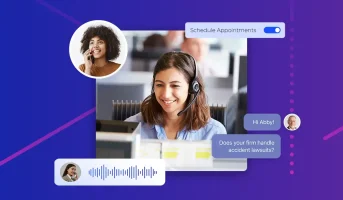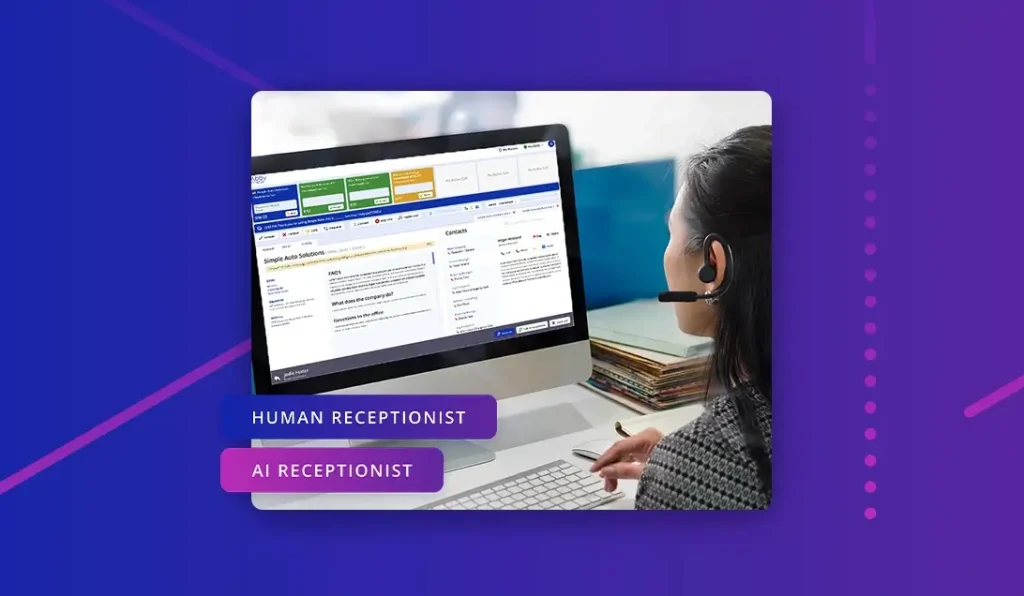
First and foremost: what is HITL AI? HITL AI stands for Human-in-the-loop AI. It’s a collaboration between humans and AI where humans actively participate in the AI system’s workflows.
Artificial intelligence is changing customer service faster than ever. Businesses are adopting AI chatbots, voice assistants, and AI receptionists to answer questions, route calls, and provide support around the clock.
But there’s a problem.
While AI adoption is accelerating, many organizations are discovering that automation alone doesn’t deliver a better customer experience. In fact, recent research from Sinch found that 74% of organizations have rolled back or shut down a live AI customer communications agent after launch.
So what separates the companies succeeding with AI from those becoming another statistic?
The answer is HITL AI, or Human-in-the-Loop AI.
Instead of replacing people, the most successful organizations combine artificial intelligence with human expertise to create faster, more accurate, and more satisfying customer experiences.
What Is HITL AI?
HITL AI (Human-in-the-Loop AI) is an artificial intelligence approach that keeps humans actively involved in AI workflows. Rather than allowing AI to make every decision independently, HITL AI uses human judgment whenever conversations become complex, emotional, or fall outside the AI’s capabilities.
In customer service, that means AI can:
- Answer common questions
- Route incoming calls
- Schedule appointments
- Gather customer information
- Handle repetitive requests
When a customer needs empathy, critical thinking, or problem-solving, the conversation is seamlessly transferred to a human who already has the full context.
The customer doesn’t start over.
The employee doesn’t waste time asking the same questions.
Everyone benefits.
Why Human-in-the-Loop AI Matters
Many businesses approach AI with one goal: Reduce costs.
The companies seeing the best results have a different objective: Improve customer outcomes.
That’s an important distinction. AI excels at repetitive, predictable work, while humans excel at empathy, judgment, creativity, and resolving unique situations.
Instead of forcing one to do the other’s job, HITL AI combines both.
As Plivo notes, successful AI systems recognize that empathy, context, and edge cases still require human judgment.
How HITL AI Works
A Human-in-the-Loop AI system follows a simple workflow.
Step 1: AI handles routine interactions
AI immediately answers common questions, captures customer information, verifies account details, and completes simple tasks.
Customers receive faster service without waiting for an available employee.
Step 2: AI recognizes its limits
When conversations become more complicated, AI looks for predefined escalation triggers.
These might include:
- Emotional language
- Billing disputes
- Multiple failed responses
- Legal or compliance questions
- Customer frustration
- Requests outside the AI’s training
Rather than guessing, the system knows when it’s time to involve a person.
Step 3: Humans take over with context
When a live employee joins the conversation, they already know:
- What the customer asked
- What AI attempted
- Account details
- Previous conversation history
The customer doesn’t have to repeat themselves.
That’s one of the biggest differences between traditional chatbots and Human-in-the-Loop AI.
Real Examples of HITL AI Success
Lyft + Anthropic
One of the best examples of HITL AI comes from Lyft.
Working with Anthropic’s Claude AI through Amazon Bedrock, Lyft built an AI-powered customer care assistant that handles initial customer inquiries. It then uses automated escalation processes to direct customers to human specialists when needed.
The result: 87% reduction in customer service resolution time.
Note that that’s not 87% cost reduction. That’s an eighty-seven percent faster resolution.
This is a critical distinction. Many AI deployments focus on reducing costs: fewer humans, lower headcount, smaller budgets. The Lyft approach focused on improving outcomes. AI makes humans more effective, and humans remain available for the work that requires human judgment.
Clarkston Consulting highlighted this case in their April 2026 analysis, noting that “humans are often able to better interpret the tone and ambiguity in messages to respond to customers with empathy, improving customer sentiment.”
Why AI-Only Customer Service Struggles
The opposite approach has produced very different results. Many organizations attempted to replace customer service teams with AI. Klarna was one of them. When they removed humans from customer service, several things happened.
Resolution quality dropped because AI couldn’t handle complex cases. Customer satisfaction tanked because customers felt unheard. Engineers and marketers got pulled into customer service because someone had to handle the volume that AI couldn’t.
The company had optimized solely for headcount reduction and created problems across other key metrics.
Eventually, Klarna shifted back toward human support after customer satisfaction declined.
The lesson wasn’t that AI doesn’t work. It was that AI works best when paired with people.
The Sinch research showing 74% of AI deployments get rolled back found that even companies with mature AI governance experienced high failure rates. More oversight didn’t prevent the fundamental problem: AI was handling situations it wasn’t equipped to handle, with no path to humans who could.
The Benefits of HITL AI
Research consistently shows the same pattern across industries. Organizations adopting Human-in-the-Loop AI see advantages over fully automated systems.
AI handles tier-one, high-volume, routine queries well. Questions like “What are your hours?” or “Where is my order?” or password reset requests. These are predictable, repetitive, and well-suited to automation.
Humans handle escalations, emotionally complex situations, and cases requiring judgment and relationship management. Billing disputes, complaints, unusual circumstances, and anything where the customer needs to feel heard. These require capabilities AI doesn’t have.
The combination outperforms either alone on both cost and satisfaction metrics.
Benefits include:
- Faster response times
- Higher first-contact resolution
- Better customer satisfaction
- More accurate decision-making
- Reduced employee workload
- Increased customer trust
- Easier quality assurance
- Continuous AI improvement through human feedback
Rather than replacing employees, HITL AI allows them to focus on conversations where they provide the greatest value.
What Successful HITL AI Looks Like
The strongest Human-in-the-Loop AI systems share several characteristics.
AI handles repetitive work
This is the front line. Routine questions get immediate responses. Basic triage happens automatically. Information gathering that doesn’t require judgment gets handled by AI, freeing humans to focus on substantive work.
Clear escalation paths
Customers can quickly reach a person whenever AI isn’t the right tool for the job. Clear triggers route to humans. Effective systems identify signals that a human is needed. This includes emotional language, repeated failed attempts, specific keywords, complexity indicators that then route accordingly.
Complete context transfer
When a human takes over, the full conversation history follows the customer. They know what has already been said and what the AI already tried. The customer doesn’t repeat themselves.
Human oversight
Humans can intervene proactively. In the best systems, human managers can monitor AI interactions and step in before problems escalate. This catches issues that automated triggers might miss and helps to continuously improve the system.
Continuous learning
Feedback improves the system. When humans handle conversations that AI couldn’t, that information should feed back into training and trigger refinement. The system learns from its limitations.
The system becomes smarter over time because people remain part of the process.
Questions to Ask Before Choosing an AI Solution
Not every AI platform supports Human-in-the-Loop workflows. For businesses evaluating solutions, the human-in-the-loop framework suggests specific questions to ask:
- How does the AI handle situations it can’t resolve? Is there a clear escalation path, or do customers hit dead ends?
- When a human takes over, what context do they receive? Do they see the full conversation, or do customers have to start over?
- What triggers escalation to humans? Is it just customer requests, or does the system proactively identify conversations that need human judgment?
- How does the company QA conversations? Are humans reviewing AI interactions to catch problems before they become patterns?
- Can you always reach a human if you need to? Or are there situations where human support simply isn’t available?
The providers who answer these questions clearly are building systems designed for real customer service. The ones who focus only on what the AI can do without addressing what it can’t are likely heading toward the 74%.
Why HITL AI Is the Future of Customer Service
The biggest misconception about artificial intelligence is that success comes from removing people. The research suggests the opposite.
The organizations achieving the best results are using AI to make people more effective, not obsolete.
When AI is used to deflect customers and cut costs, it creates frustration and erodes trust. When it’s used to support human agents and improve resolution, AI can genuinely improve customer experience.
The difference is human-in-the-loop design: building systems that recognize AI’s limitations, keep humans available for the work that requires human judgment, and create smooth handoffs between the two.
AI handles speed. Humans provide judgment.
AI delivers efficiency. Humans build trust.
Together, they create better customer experiences than either could alone.
That’s the promise of Human-in-the-Loop AI. And it’s why the companies embracing HITL AI today are increasingly becoming tomorrow’s customer service leaders.
The 74% deployed AI to replace humans. The winners deployed AI to make humans more effective.
Why Abby Connect Is Different
At Abby Connect, our AI is built on 20+ years of answering service expertise. We didn’t pivot to AI; we built AI into what we already knew.
It’s not humans vs. AI. It’s AI powered by human experience. Talk to our team to learn more about how the Abby AI Receptionist helps businesses with our technology.
Frequently Asked Questions
What does HITL AI stand for?
HITL AI stands for Human-in-the-Loop AI, an approach that combines artificial intelligence with human oversight to improve accuracy, customer experience, and decision-making.
Why is Human-in-the-Loop AI important?
HITL AI allows businesses to automate repetitive work while ensuring customers can quickly reach a knowledgeable person when situations require empathy, judgment, or problem-solving.
Is HITL AI better than fully automated AI?
For customer service, many organizations find that Human-in-the-Loop AI delivers better customer satisfaction because AI handles routine tasks while humans resolve more complex issues.
What are examples of HITL AI?
Customer service is one of the most common examples. AI answers frequently asked questions, gathers customer information, and routes conversations, while human agents resolve complicated requests that require context or empathy.